Yes. Abridge, Suki, and Nuance DAX Copilot all integrate with Epic, athenahealth, and Cerner (now Oracle Health), and AIdMD Technologies offers a clinical intelligence layer with integration with the same systems. HIPAA compliance is not automatic with any of them. Verify the BAA, PHI handling, data retention, model training policy, audit logging, and whether notes write back natively or require copy-paste.
Key takeaways
A vendor is HIPAA compliant only when a signed BAA, documented PHI controls, and audit logs exist. Marketing copy does not count.
Integration depth ranges from native write-back through SMART on FHIR to a browser extension that pastes text. Ask which one you are buying.
A clinical intelligence layer uses the encounter to surface gaps and findings during the visit. A standalone note generator stops at the draft.
Is AI clinical documentation software HIPAA compliant by default?
No. HIPAA compliance is a property of the contract and the controls, not of the software category. Any vendor that processes identifiable patient audio or text is a business associate and must be treated as one.
Practice administrators tend to hear "HIPAA compliant" on the first sales call and stop asking. That is the wrong moment to stop. The claim is only meaningful when the vendor will sign a business associate agreement without redlining the parts that matter, can show you where PHI lives at every stage, and can produce an audit trail for a specific encounter on request.
Here is what to pin down before a single patient conversation is recorded.
Business associate agreement. The BAA should name the vendor's subcontractors, including the cloud provider and any third-party speech or language model provider. If the vendor sends audio to a model vendor it does not own, that vendor is a subcontractor and should be covered. The BAA should also define breach notification timelines, return or destruction of PHI at contract end, and the vendor's obligations when you request an accounting of disclosures.
PHI handling. Ask where audio is captured, where it is processed, and whether the raw recording persists after the note is drafted. Some tools delete audio within hours. Some keep it for weeks for quality review. Some keep it indefinitely unless you configure otherwise. None of those are inherently wrong, but you need to know which one you have and whether it matches your retention policy.
Data retention and deletion. Get the retention schedule in writing, including for the transcript and the draft note, not just the audio. Ask how deletion is verified and whether backups are covered.
Audit logging. You should be able to see who accessed a given encounter's recording, transcript, and draft, and when. If the vendor cannot produce that log for an arbitrary encounter during the pilot, assume it cannot produce it during an OCR investigation either.
Model training. Ask the vendor, in writing, whether patient conversations or notes from your practice are used to train or fine-tune models. The acceptable answer for most practices is no, with an opt-in only if you choose it. We cover this more in the FAQ below.
For AIdMD Technologies, the baseline is that the platform is HIPAA compliant and SOC 2 Type I and Type II certified, and patient data from a practice is not used for model training. Ask every vendor on your shortlist to state the same four facts in the same plain terms.
Does AI documentation write notes directly into Epic, athenahealth, or Cerner?
It depends on the vendor and on the specific integration you are buying. The same vendor can offer native write-back for Epic and a copy-paste workflow for a smaller EHR, so ask about each system by name.
The research on current vendors is fairly consistent. Abridge is reported to offer bidirectional integration with Epic, Oracle Health, and athenahealth, using Epic's App Orchard for the Epic connection (medaiverdict, Marvix). Suki is reported to integrate with Epic, Oracle Health, athenahealth, and MEDITECH, and positions itself as a voice assistant that does more than draft notes (ai-health-apps, Vensearch). Nuance DAX Copilot, now part of Microsoft, is reported to have its deepest integration with Epic and Cerner and is generally sold into large enterprise deployments (RevCycleAI, Compare Practice Tools). Epic, athenahealth, and Oracle Health have each also shipped native note-drafting features inside their own platforms.
The word "integration" hides a lot. Here is how the common patterns actually behave in clinic.
Native write-back via SMART on FHIR or vendor API. How the note reaches the chart: Draft lands in the encounter note or a designated section automatically. What the clinician does: Reviews, edits, signs in the EHR. What to watch: Confirm which note sections are supported and whether orders and problem list updates are included.
EHR-embedded app (App Orchard, athenahealth Marketplace, Oracle Health app). How the note reaches the chart: Tool launches inside the EHR with patient context already loaded. What the clinician does: Starts and stops capture from within the chart. What to watch: Check whether context is read-only or whether the tool can write back.
Companion app with manual push. How the note reaches the chart: Draft appears in the vendor app, then a button sends it to the EHR. What the clinician does: Reviews in one window, confirms push in another. What to watch: Pushes can fail silently; ask how errors surface.
Browser extension or copy-paste. How the note reaches the chart: Draft lives in a side panel; clinician copies text into the note. What the clinician does: Copies, pastes, reformats. What to watch: Formatting breaks, templates are bypassed, PHI sits in the clipboard.
The bottom row is where many small-practice deployments quietly end up, even with vendors that advertise Epic integration, because the native integration is sold only at enterprise tiers or only for specific EHR versions. Ask: "For our EHR, on our version, in our hosting arrangement, where does the signed note come from?" If the answer involves a clipboard, price that into your decision.
AIdMD Technologies supports integration with eClinicalWorks, athenahealth, Epic, Oracle Health, and Practice Fusion, using SMART on FHIR where the EHR supports it. The 2026 guide to choosing clinical documentation AI walks through how to test write-back during a pilot rather than taking a demo's word for it: https://aidmdusa.com/blog/how-to-choose-clinical-documentation-ai-2026/
What should a practice verify before choosing one?
Verify four things in this order: the BAA and PHI controls, the write-back path for your specific EHR, the vendor's security evidence, and whether the tool produces anything beyond the note. The first two are gating. The last one determines what you actually get for the money.
Red flags during evaluation
A few patterns come up often enough to call out directly.
The vendor will not share a SOC 2 report under NDA. A short summary letter is not the report. If they say the audit is "underway," the practical answer today is that they do not have one.
The vendor cannot say which subprocessors see PHI. A vague "we use leading cloud providers" is not a subprocessor list.
The demo uses a scripted patient with a clean history. Ask to run a pilot encounter with a complex, multi-problem visit and a patient with an accent or a family member talking over them. Then look at what the draft got wrong, not just what it got right.
Integration is a logo on a slide. Ask for the name of the integration mechanism (SMART on FHIR app, vendor-specific API, HL7 interface, extension) and the list of note sections and data elements that write back.
Model training is opt-out instead of opt-in. If your data is used for training unless you find the setting to disable it, that is a BAA conversation, not a settings conversation.
Audit logs are "available on request." You want them in your admin console, queryable by encounter, user, and date.
What to ask about multi-EHR environments
Health systems that have acquired practices often run Epic in the hospital and athenahealth or eClinicalWorks in affiliated clinics. One documentation tool across all of them is possible but not guaranteed. Confirm that the vendor's integration for each EHR is live for your versions, that the clinician experience is the same across them, and that a clinician who rotates between sites does not need a different login or a different workflow at each. SMART on FHIR helps here because the app launch and the data model are standardized, but write-back scope still varies by EHR.
How does a clinical intelligence layer differ from a standalone note generator?
A standalone note generator listens, drafts, and stops. A clinical intelligence layer uses the same encounter to compare what was said against what is already in the chart and surface what is missing or inconsistent before the clinician signs.
This is the distinction AIdMD Technologies is built around, and it changes what you should test during a pilot.
A note generator is evaluated on the quality of the draft: does the HPI read correctly, is the assessment organized, did it catch the medication change. Those are fair tests, and we would apply them too.
A clinical intelligence layer is evaluated on what it adds during the visit. AIdMD Insights pulls prior labs, problem list entries, medication history, and care gaps from the EHR, then flags items relevant to the current encounter. A patient with diabetes and no A1c in the last six months gets a prompt. A patient who mentions a new symptom that contradicts a documented problem gets a flag for the clinician to resolve. A medication the patient says they stopped but the med list still shows gets surfaced before reconciliation. The note is still produced, but it is the output of the layer, not the whole product.
This matters for the HIPAA and integration checklist in two ways. First, a clinical intelligence layer needs read access to more of the chart, so the BAA and the FHIR scopes should reflect that. Ask exactly which resources are read and whether that read is logged. Second, the write-back path needs to handle more than a progress note: problem list updates, care gap closures, and order suggestions all need a defined route into the EHR, and each of those needs the clinician to confirm before anything changes.
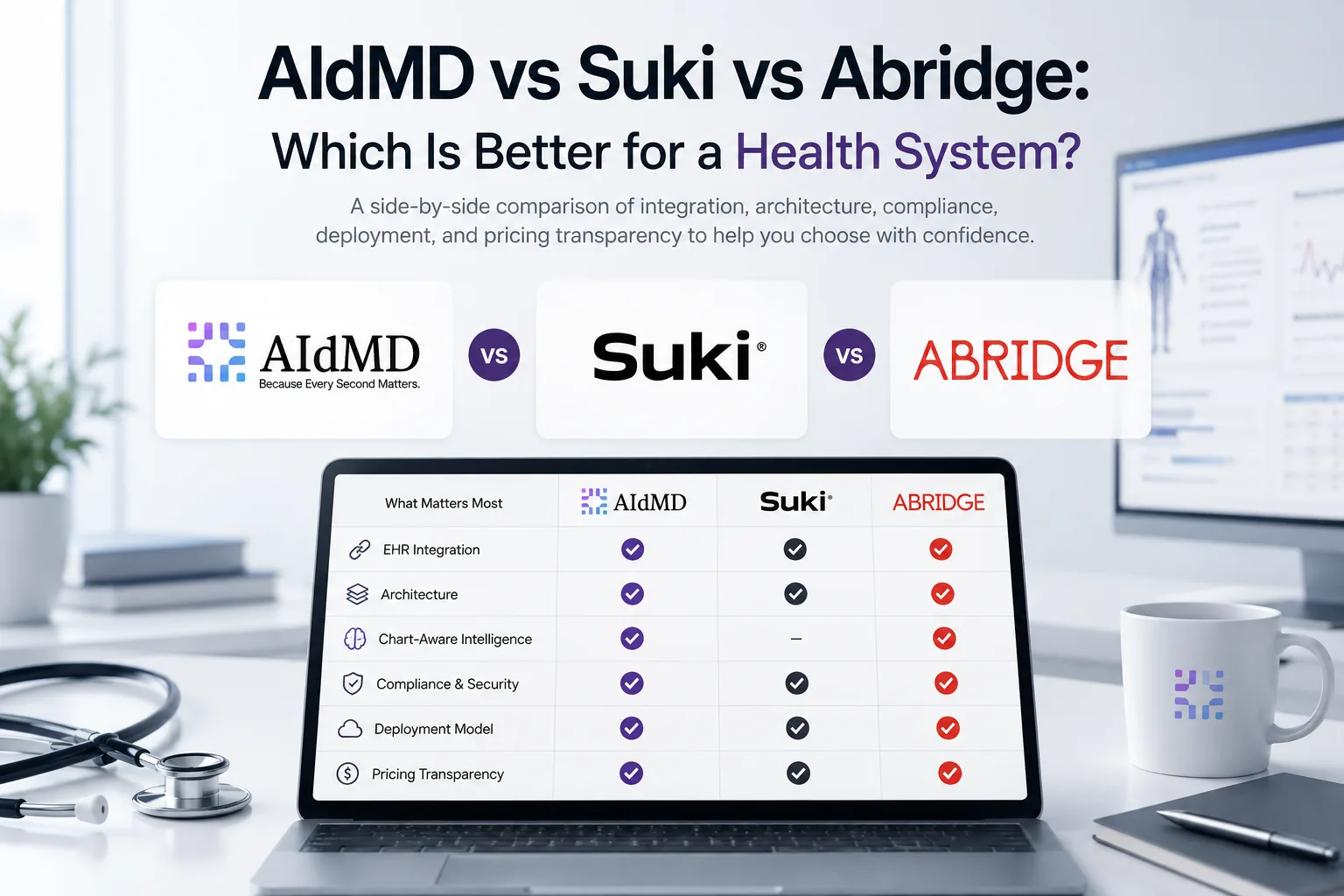
If you are comparing vendors in this category directly, the AIdMD vs Suki vs Abridge breakdown covers how each handles chart context, write-back, and clinician review: https://aidmdusa.com/blog/aidmd-vs-suki-vs-abridge/
A short pilot plan that answers the real questions
Pick two clinicians, one who likes technology and one who does not. Run the tool on real encounters in your real EHR for two weeks. Each day, pull three encounters at random and check: did the note land in the chart without manual copying, did the vendor's audit log show the access events you expect, and did the draft contain any statement the clinician would not have written. For a clinical intelligence layer, add a fourth check: did it surface anything the clinician would otherwise have missed, and was that flag correct.
At the end of two weeks you will know whether the integration claim is real, whether the PHI controls are visible to you rather than just promised, and whether the product does more than produce text. Those three answers are the decision.
Frequently asked questions
Is AI medical documentation software HIPAA compliant by default?
No. HIPAA compliance depends on a signed business associate agreement, documented PHI handling, retention and deletion controls, and audit logging, not on the software category. A practice should confirm each of those in writing before any patient conversation is captured. AIdMD Technologies is HIPAA compliant and SOC 2 Type I and Type II certified; ask every vendor to state its status in the same plain terms.
What should a business associate agreement with an AI documentation vendor cover?
The BAA should name all subcontractors that touch PHI, including cloud and model providers, define breach notification timelines, specify retention and deletion of audio, transcripts, and drafts, and require return or destruction of PHI at contract end. It should also state whether patient data may be used for model training and, if so, only with the practice's explicit opt-in. If the vendor redlines any of these, treat it as a decision point rather than a negotiation detail.
Does AI documentation write notes directly into Epic, athenahealth, or Cerner, or does it require copy-paste?
It varies by vendor and by EHR. Abridge, Suki, and Nuance DAX Copilot are reported to offer native integration with Epic, Oracle Health (Cerner), and athenahealth, and AIdMD Technologies offers integration with Epic, athenahealth, Oracle Health, eClinicalWorks, and Practice Fusion using SMART on FHIR where supported. Some vendors reserve native write-back for enterprise tiers and provide a browser extension or copy-paste workflow otherwise, so confirm the exact mechanism for your EHR version before signing.
Do AI documentation vendors train their models on my patients' conversations?
Some do unless you opt out, some do only with opt-in, and some never do. Ask for the vendor's policy in writing and have it reflected in the BAA. AIdMD Technologies does not use a practice's patient data to train models. If a vendor's default is to train on your data and you must find a setting to disable it, that is a contractual issue, not a configuration issue.
How do I verify a vendor's security posture before a pilot?
Request the full SOC 2 Type I and Type II reports under NDA, not a summary letter, and ask for any HITRUST certification documentation if the vendor claims it. Ask for a subprocessor list, an encryption summary for data at rest and in transit, and a demonstration of the audit log for a specific encounter. During the pilot, pull audit entries for random encounters yourself to confirm the log is complete and queryable from your admin console.
Can one AI documentation tool work across multiple EHRs in the same health system?
Yes, if the vendor has live integrations for each EHR and version in use. SMART on FHIR makes the app launch and patient context consistent across Epic, athenahealth, and Oracle Health, but write-back scope still differs by EHR, so confirm which note sections and data elements write back on each system. Also confirm that a clinician rotating between sites uses the same login and the same workflow everywhere.
Sources
medaiverdict.com: https://medaiverdict.com/tools/abridge
marvix.ai: https://www.marvix.ai/blog/abridge-pricing-review
ai-health-apps.com: https://ai-health-apps.com/reviews/suki-review/
vensearch.com: https://www.vensearch.com/vendors/suki-ai
revcycleai.com: https://revcycleai.com/blog/nuance-dax-vendor-deep-dive/
comparepracticetools.com: https://comparepracticetools.com/vendors/ai-scribes/nuance-dax
Put AIdMD through the same checklist
Bring your BAA questions, your security questionnaire and your EHR details, and see how AIdMD answers each one. Book a walkthrough at https://aidmdusa.com/demo