Does Your EHR's Native AI Make a Separate Clinical Intelligence Layer Unnecessary?
By AIdMD Team
The question comes up in almost every conversation with practice administrators now. Epic has shipped AI features across its stack. Oracle Health is rebuilding its EHR around an embedded assistant. If the platform you already pay for is adding intelligence, why sign a second contract?
It is a fair question and it deserves a real answer rather than a sales response. The short version: native EHR AI is genuinely useful, and it is genuinely bounded. It works well inside the system that produced it, for the workflows that system controls, for the users who log into that system. Most health systems do not operate inside those boundaries. They operate across an inpatient EHR, an ambulatory instance from an acquisition three years ago, a behavioral health platform, a standalone imaging system, a home health record, and four or five point solutions that each do one thing.
Native AI does not solve that. It multiplies it.
What native EHR AI actually does well
Give the platform vendors credit. When AI lives inside the EHR, it has advantages a third party has to work for.
It sees the full record without an interface. No HL7 mapping, no FHIR scope negotiation, no lag between the moment a lab resulted and the moment an external system knows about it. Native AI reads the chart the way the chart is stored.
It writes back cleanly. An external tool that wants to drop a suggested order into the queue has to get through the vendor's write pathway, and those pathways are narrower than most people expect. Native features skip that entirely.
It lands where the user already is. No second login, no separate tab, no browser extension that breaks after an upgrade. Adoption is easier when the feature shows up inside a screen the physician already opens forty times a day.
For a single-instance shop running one EHR across every site of service, with no plans to acquire anything, native AI covers a meaningful amount of ground. If that describes your organization, the honest answer is that you have less to gain from an additional layer than a multi-EHR system does.
Most organizations are not that.
Where native AI stops
The limits are not about quality. They are structural, and they show up in four predictable places.
It ends at the platform boundary
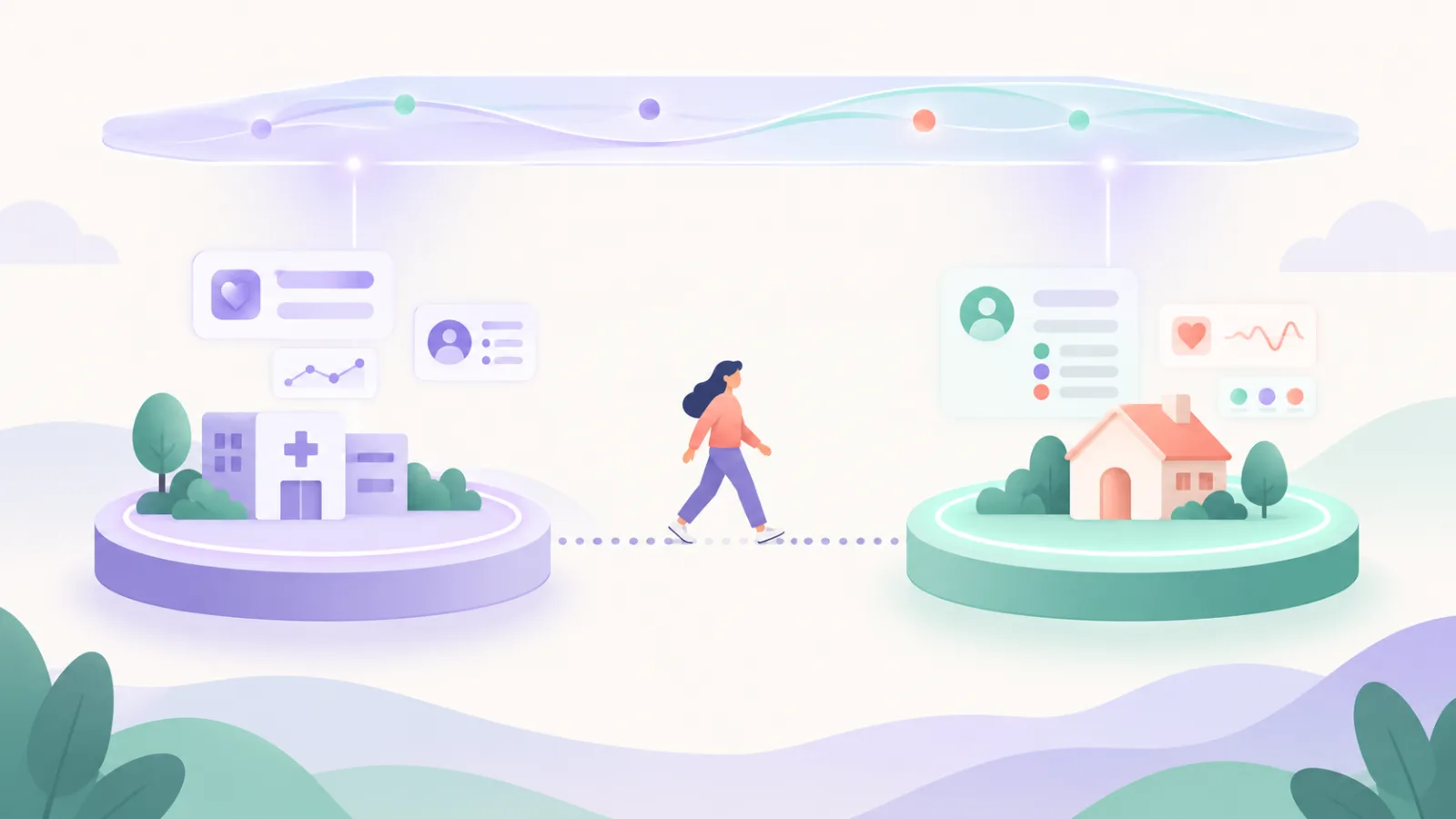
Epic's AI reasons over Epic data. Oracle's reasons over Oracle data. Neither has an incentive to build a first-class view of the other, and neither will do the work of reconciling a patient's problem list across both. If your health system runs Epic on the inpatient side and something else in ambulatory, or acquired a group still on athenahealth, or runs a separate platform for behavioral health, native AI gives you two or three intelligent systems that cannot see each other. The patient moves between them. The intelligence does not.
It follows the vendor's roadmap, not your priorities
Platform vendors build for the aggregate customer base. That is rational for them and frustrating for you. If your highest-value problem is closing risk-adjustment gaps in a specific Medicare Advantage population, or reducing avoidable transfers from your skilled nursing partners, or catching sepsis earlier in an ED that does not use the standard triage flow, you wait. You submit an enhancement request and you wait. A layer that sits above the EHR can be pointed at your problem this quarter.
It cannot orchestrate across tools
This is the one administrators underestimate. By the time a health system evaluates native AI, it typically already owns several AI or algorithmic tools. A deterioration model. A coding assistant. A radiology triage product. An imaging vendor's detection algorithm. A payer-facing prior authorization tool. Each fires independently. Each generates an alert or a task or a score. None of them know the others exist.
So a patient with a rising deterioration score, an incidental nodule flagged by imaging, and an open care gap generates three separate signals to three separate inboxes for three separate people, none of whom see the full picture. Native EHR AI adds a fourth signal. It does not consolidate the first three.
Governance and measurement fragment with it
Ask a compliance officer which AI-generated recommendations were accepted, which were overridden, and what happened to the patient in each case. Now ask that across five systems. Native AI reports on itself, in the format the vendor chose, inside the vendor's analytics module. Building a defensible organization-wide picture of model performance, drift, and clinical impact out of those separate reports is manual work that nobody has budget for.
What does a clinical intelligence layer actually do that the EHR does not?
A clinical intelligence layer sits above the record systems rather than inside any one of them. Its job is not to be another AI feature. Its job is to unify the ones you have and to reason across the data all of them produce.
Concretely, that means four things.
It normalizes across sources. Data arriving from Epic, Oracle, athenahealth, a lab interface, an ADT feed, and a claims file gets mapped to a common representation. Same patient, same problem, same medication, regardless of which system captured it and which local code set that system uses. AIdMD's integration with major EHR vendors is what makes this practical rather than theoretical.
It runs reasoning that no single system has the inputs for. A readmission signal that combines discharge data from the inpatient EHR, a missed follow-up in the ambulatory system, a pharmacy fill gap, and an ADT ping from an unaffiliated ED is not a model any one platform can build. It needs the whole picture.
It orchestrates existing tools instead of duplicating them. If your deterioration model already works, the layer consumes its output rather than replacing it. If your imaging vendor's algorithm flags a finding, the layer routes it to the right owner with the right context and tracks whether it closed. The point is coherence across point tools, not another point tool.
It maintains one audit and governance surface. One place to see which recommendations were surfaced, to whom, when, what action followed, and how the model performed against outcomes over time. That matters for internal quality review and it matters when a regulator or a malpractice carrier asks.
None of this competes with native EHR AI. It sits at a different altitude.
Is this a build-versus-buy or a both question?
Both, and the sequencing matters.
Turn on the native features. They are included in what you already pay for, they require no new interface work, and they will handle a real slice of your workflow. Turn them on, measure them, and let physicians tell you where they help.
Then look at what is left. In most multi-site systems, what is left looks like this:
Patients whose care crosses two or more record systems, where nothing has the full chart.
Populations you are financially at risk for, where the relevant data lives partly outside any EHR.
Existing AI tools generating signals nobody is consolidating or closing the loop on.
Transitions of care, the highest-risk moments and the ones with the worst data continuity.
Any clinical question that requires claims, SDOH, or external ADT data alongside the chart.
That residual list is the case for a layer. If your residual list is short, do not buy anything. If it describes your daily operational pain, native AI is not going to reach it, because reaching it requires seeing outside the platform.
How to evaluate this without getting sold to
A few questions that separate substance from a demo.
Ask any vendor, including your EHR vendor, to show you a workflow that spans two different record systems. Native AI cannot do this. Some third-party tools cannot either. It is a fast filter.
Ask what happens to the AI tools you already own. If the answer is "replace them," you are buying a point solution with a better pitch. A layer should ingest and orchestrate them.
Ask how the vendor handles security and privacy specifically, not generally. AIdMD is SOC 2 Type I and Type II certified and HIPAA compliant, and you should expect a vendor to name their certifications rather than gesture at them.
Ask for the governance artifact. Not a dashboard screenshot. The actual record of what was recommended, what was accepted, what was overridden, and what the downstream outcome was. If a vendor cannot produce that, they are not thinking about the part of this that will eventually matter most.
Ask what happens when your EHR upgrades. Interfaces break. A layer that requires three weeks of remediation after every quarterly release is a maintenance liability dressed up as intelligence.
The framing that holds up
Native EHR AI is a platform feature. It makes the platform better at what the platform already does, for the users already inside it. That is worth having.
A clinical intelligence layer is infrastructure. It exists because care does not happen inside one platform, and because the AI you have accumulated over the last four years is not talking to itself. The layer's value scales with your fragmentation. One EHR, one site, one workflow: low. Multiple EHRs, multiple settings, several AI tools already running, financial risk on a population: high.
The question is not which one wins. It is how much of your clinical reality falls outside the boundary of any single system. Answer that honestly and the buying decision mostly answers itself.
Frequently asked questions
Is Epic's or Oracle's built-in AI enough for my health system, or do I still need a separate clinical AI layer?
If you run a single EHR instance across every site of service and have no plans to acquire practices on other platforms, native AI covers a substantial share of what you need. If your patients move between two or more record systems, or you are financially at risk for a population whose data lives partly outside any EHR, native AI will not reach those cases because it cannot see past its own platform boundary. Start with the native features, measure what they cover, then evaluate the residual.
What is the difference between native EHR AI and a clinical intelligence layer?
Native EHR AI is a feature inside a specific platform. It reasons over that platform's data and surfaces results inside that platform's screens. A clinical intelligence layer sits above the record systems, normalizes data from all of them, runs reasoning that requires inputs from multiple sources, and provides one governance and audit surface across every AI tool the organization runs.
Can a clinical intelligence layer work alongside native EHR AI instead of replacing it?
Yes, and that is the intended design. A layer should consume the outputs of existing AI, including native EHR features, deterioration models, imaging algorithms, and coding tools, then consolidate and route them with full patient context. If a vendor's answer is to replace the tools you already own, you are looking at another point solution rather than a layer.
Why do multi-EHR health systems still struggle with fragmented AI even after vendors add native AI features?
Because each vendor's AI reasons only over that vendor's data, adding native features to three EHRs produces three intelligent systems that cannot see each other. Patients cross the boundaries, the intelligence does not, and each system generates its own alerts to its own inboxes with its own reporting format. Fragmentation increases with each new native feature unless something above the platforms unifies the signals.
See where your residual list actually is
The fastest way to size the gap is to walk one patient whose care crosses two of your record systems and see what each system knows. Book a walkthrough at https://aidmdusa.com/demo