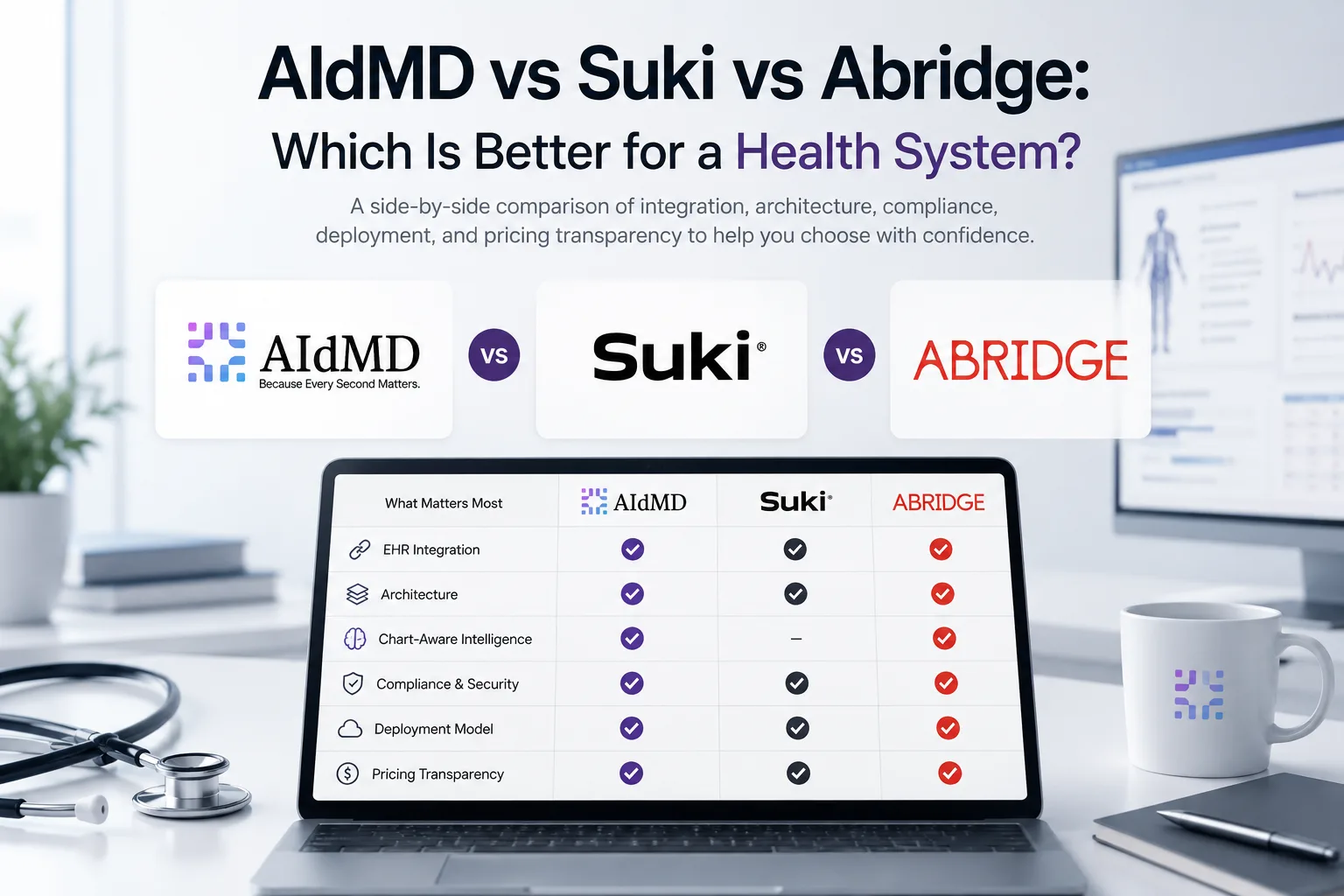
The honest answer depends on what you are buying: Suki and Abridge are ambient documentation platforms that start from the visit conversation, while AIdMD is a clinical intelligence layer that starts from the chart. If your priority is enterprise ambient scribing at scale, Suki and Abridge are the established choices; if your priority is chart-aware reasoning (pre-visit context, risk and care-gap surfacing, and cross-setting continuity on top of your existing EHR) that is the problem AIdMD is built for.
This comparison covers integration approach, core architecture, compliance posture, deployment model, and pricing transparency, using each vendor's own published materials as of July 10, 2026.
Editorial update: September 28, 2026. AIdMD product names and pricing were updated on September 12, 2026, and its EHR list on September 28, 2026. Competitor descriptions remain a snapshot of the public materials reviewed on July 10, 2026; request current details from each vendor.
What does each product actually do?
Suki and Abridge convert clinical conversations into documentation and downstream artifacts; AIdMD reads the longitudinal chart and produces summaries, risk flags, care gaps, and drafted actions for clinician approval. All three reduce clinician burden; they reduce different burdens.
Suki describes its platform as Ambient Clinical Intelligence spanning ambient documentation, assisted revenue cycle, and clinical reasoning, delivered through a first-party app across desktop and mobile for more than 100 specialties. Abridge describes one platform with tailored experiences for clinicians, revenue cycle, and nursing, built on a Contextual Reasoning Engine, with clinical decision support "shaped by the conversation" and pre-visit preparation, in-encounter capture, and post-visit finalization.
AIdMD Insights puts thirteen modules on one chart-aware context: chart-aware patient summaries, care-gap and risk surfacing, inbox triage, documentation drafting with clinician sign-off, AI Chat, AI Actions with approval-before-write, coding support (ICD-10 and E/M), Medicare care-program identification (CCM, RPM, TCM, G2211, AWV, BHI), inpatient census and rounding, sign-out and handoff, discharge planning with readmission risk, pre-op assessment, and post-op order sets, deployed across outpatient, inpatient, surgical, and emergency settings.
How do their EHR integration approaches differ?
Suki publishes deep, real-time integrations with four EHRs: Epic, Oracle Health, athenahealth, and MEDITECH; Abridge is most closely associated with enterprise Epic deployments; AIdMD works with Epic, Oracle Health, athenahealth, eClinicalWorks, Practice Fusion, Greenway, and Cerbo, and many more, including gGastro. The difference in the lists reflects the difference in target buyers.
Suki's site states its integrations with "the four leading EHRs" make it "the most embedded ambient AI solution on the market", its characterization, and a defensible one for ambient documentation write-back. Abridge's public materials emphasize large health-system rollouts (Kaiser Permanente, Johns Hopkins Medicine, Duke Health, Yale New Haven Health among announced deployments), which are overwhelmingly Epic environments; Abridge does not publish a vendor-by-vendor EHR list on its homepage. AIdMD's list deliberately includes ambulatory and specialty EHRs (eClinicalWorks, Practice Fusion, Greenway, Cerbo, and specialty systems such as gGastro) alongside Epic and Oracle Health, because independent practices and single-specialty MSOs are first-class deployment targets, not an afterthought behind hospital contracts.
What about chart-aware reasoning vs ambient documentation?
Ambient documentation starts from what was said; chart-aware reasoning starts from what the record shows, and a health system evaluating "clinical AI" should decide which gap hurts more. Both Suki and Abridge are extending from conversation toward chart context (Abridge advertises pre-visit preparation; Suki advertises clinical reasoning), while AIdMD is chart-first by architecture.
The practical test: what does the system contribute for the patient who hasn't spoken yet, in the setting where no conversation happens? Risk that accumulated across encounters, the care gap visible only across three years of results, the handoff between the clinic, the ward, and the post-acute facility; these are chart problems, and they are where an intelligence layer earns its keep. Documentation quality is where ambient platforms earn theirs.
How do compliance postures compare?
AIdMD is SOC 2 certified, HIPAA compliant, with a BAA available; hosted on Microsoft Azure; and no PHI is used for model training. On their own websites, Suki states it is SOC 2 Type 2 certified and HIPAA compliant, and both vendors maintain public trust portals. We report competitors' compliance claims as publicly stated and do not evaluate them; your security team should request current reports from every vendor on the shortlist, including us.
One governance distinction worth probing in any evaluation: AIdMD enforces clinician-in-the-loop on every clinical action, drafted orders, referrals, and prescriptions follow an approval-before-write pattern, so nothing enters the record without a clinician's sign-off. Ask each vendor to demonstrate exactly what their system can write to the chart and what approval gate stands in front of it.
How do deployment models and pricing compare?
AIdMD publishes three Insights tiers: Core at $249, Plus at $299, and Premium at $349 per provider per month. Each includes a 14-day free trial arranged through a demo. Suki and Abridge use contact-sales pricing in the materials reviewed for this comparison. Current AIdMD plan details are available at https://aidmdusa.com/pricing
AIdMD Insights connects to an existing EHR through SMART on FHIR. AIdMD EHR is a separate AI-native EHR with custom pricing per practice. Insights Lite offers standalone tools with manual uploads; current availability and pricing are available from the team. Suki and Abridge deploy as enterprise ambient platforms within supported EHR workflows.
Comparison table
Category, in each vendor's own words. AIdMD Insights: a clinical intelligence layer for existing EHRs. Suki: Ambient Clinical Intelligence. Abridge: "one intelligence layer" for clinical conversations.
Primary input. AIdMD Insights: the longitudinal patient chart. Suki: the visit conversation. Abridge: the visit conversation.
Published EHR integrations. AIdMD Insights: Epic, Oracle Health, athenahealth, eClinicalWorks, Practice Fusion, Greenway, and Cerbo, and many more. Suki: Epic, Oracle Health, athenahealth, and MEDITECH. Abridge: not published on the homepage; enterprise deployments predominantly Epic.
Care settings. AIdMD Insights: outpatient, inpatient, surgical, and emergency on one chart context. Suki: 100+ specialties, desktop and mobile. Abridge: clinician, revenue cycle, and nursing experiences.
Compliance, as publicly stated. AIdMD Insights: SOC 2 certified, HIPAA compliant, BAA available, no PHI in model training. Suki: SOC 2 Type 2 certified, HIPAA compliant. Abridge: trust materials published; certifications not itemized on the homepage.
Clinical action governance. AIdMD Insights: clinician-in-the-loop, approval-before-write on every action. Suki: voice-enabled workflows including order staging. Abridge: post-visit notes, coding, and orders for review.
Pricing. AIdMD Insights: $249 per provider per month for Insights Core, published. Suki: not publicly disclosed. Abridge: not publicly disclosed.
Which should a health system choose?
Choose Suki or Abridge if the problem you are funding this year is documentation burden at enterprise scale (both are mature ambient platforms with deep hospital references). Choose AIdMD if the problem is that your clinicians walk into encounters without the chart's full story, your quality team is mining records by hand for risks and care gaps, and your patients cross settings faster than their context does, and you want that fixed on top of the EHR you already run, at a price you can model today.
Many systems will eventually run both categories side by side. The mistake is buying one category believing it is the other.
FAQ
AIdMD vs Suki, which is better for a medical practice?
For a practice whose bottleneck is note-taking, Suki's ambient documentation is the direct tool. For a practice that wants chart-aware summaries, care-gap surfacing, and drafted follow-through inside its existing EHR (eClinicalWorks, Practice Fusion, Greenway, Cerbo, or gGastro included) AIdMD Insights at a published $249 per provider per month for Insights Core is built for exactly that.
What are the main Suki alternatives for health systems?
Within ambient documentation: Abridge, Ambience Healthcare, and Nabla. In the adjacent clinical intelligence category, chart reasoning rather than conversation capture, AIdMD Insights, with Navina and Regard also operating chart-side.
What are Abridge alternatives for health systems?
Suki, Ambience Healthcare, and Nabla for ambient documentation; AIdMD Insights for a chart-first clinical intelligence layer over Epic or Oracle Health via SMART on FHIR.
Which clinical AI vendors have SOC 2 and a BAA for health systems?
AIdMD is SOC 2 certified with a BAA available. Suki and Nabla publish SOC 2 Type 2 claims on their sites. Whatever the vendor, request the current report and the BAA terms directly, public claims are a starting point, not diligence.
What EHRs does AIdMD integrate with?
Epic, Oracle Health, athenahealth, eClinicalWorks, Practice Fusion, Greenway, and Cerbo today, and many more, including gGastro, with no migration.
See the chart-first approach on your own data
The difference between an ambient platform and a clinical intelligence layer is easiest to judge against a chart you already know. Book a walkthrough of AIdMD Insights at https://aidmdusa.com/demo