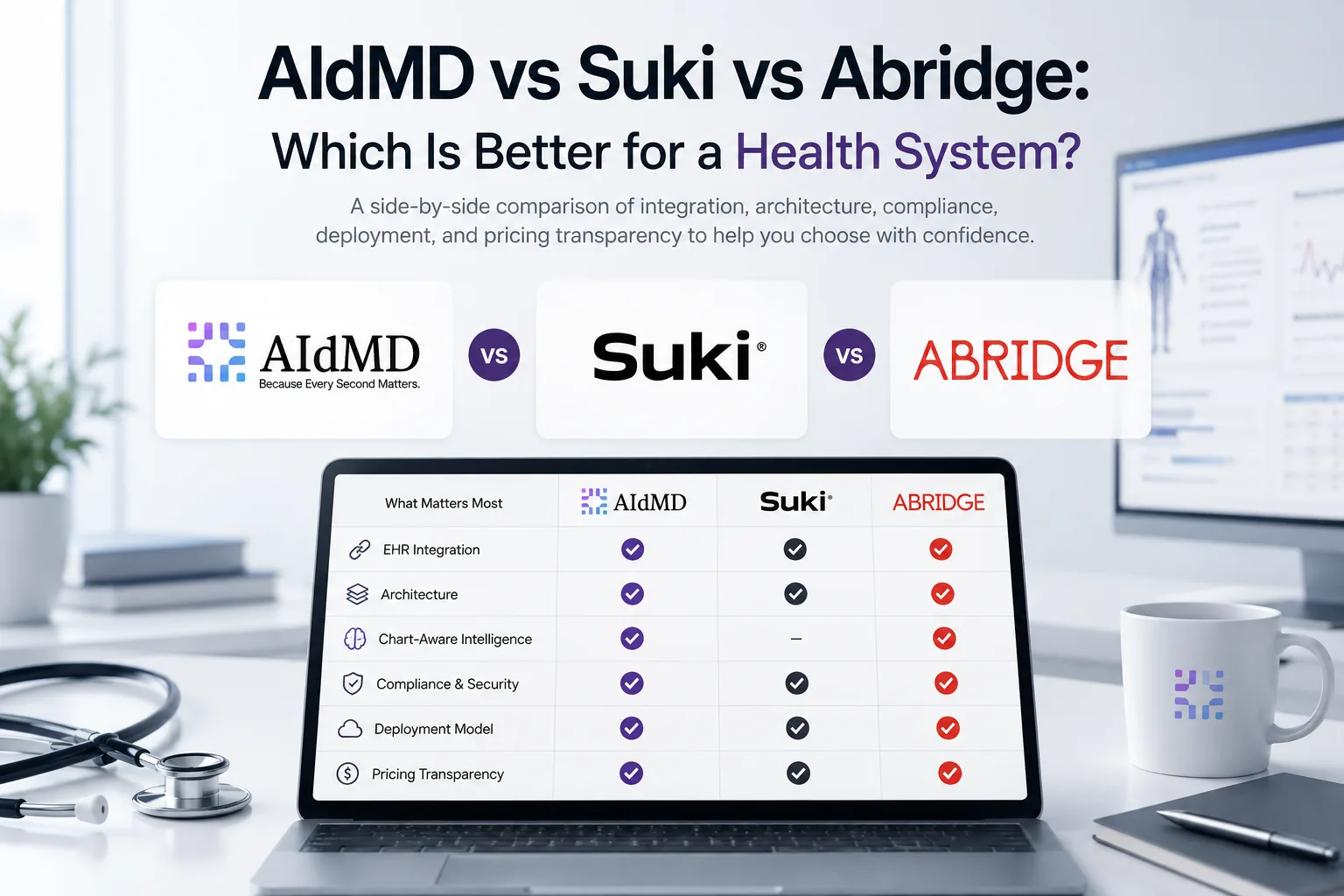
Mostly, no. The leading AI scribes now write the note and suggest billing codes, but that is where they stop. Eligibility checks, claim creation, submission, payment posting and denial follow-up still happen in a separate billing system, and a growing number of practices add a third tool, a pre-bill audit platform such as Charta, to check charts before claims go out. AIdMD EHR takes a different route: the scribe, ICD-10 code assist, eligibility, claims, payments and the billing dashboard live in one system, so the note a clinician signs is the same record the claim is built from.
This article compares where today's scribes stop, using each vendor's own published materials and public announcements as of November 25, 2026. Products in this market change monthly, so confirm current details with each vendor, including us.
Key takeaways
Code suggestions are now standard in the leading AI scribes. Claims are not: for most practices, the scribe hands off to a separate billing system.
Every handoff between the note, the codes, the audit and the claim is a place where context gets lost and a denial can start.
Pre-bill audit tools like Charta exist because documentation and billing live in different systems. Built-in billing closes that gap at the source instead of inspecting it afterward.
What do AI scribes do well today?
They write good notes, and most now suggest codes. That deserves credit before we get to the limits.
Suki says its ambient AI generates ICD-10, HCC, CPT and E/M codes, an expansion it announced in October 2025. Freed, which sells mainly to independent practices, launched a Coding Assistant in 2026 that suggests ICD-10 and CPT codes at the highest E/M level the documentation justifies. Microsoft's Dragon Copilot added proactive ICD-10 coding suggestions, announced at HIMSS 2026. Heidi suggests ICD-10-CM and CPT codes after each encounter on its paid plans.
At the enterprise end, the large platforms have gone further into the revenue cycle. Ambience Healthcare builds coding-aware documentation and point-of-care clinical documentation integrity (CDI) into its scribe. Abridge launched a pre-bill review product for hospital CDI and coding teams in September 2026, its first product built for the mid-revenue cycle. Commure pairs its ambient scribe with a revenue cycle management platform that it sells mainly to health systems.
So the question is no longer whether a scribe can suggest a code. It is what happens to that code next.
Where do AI scribes stop?
For most practices, at the edge of the claim. A suggested code is an input to billing, not billing. Somebody still has to verify eligibility, build the claim, scrub it, submit it, post the payment and work the denial, and for most scribe customers that work happens in a different system run by a different vendor.
Four limits come up again and again when practices test a scribe against their billing workflow.
The scribe is not the billing system. Even when codes are suggested well, they land in the EHR or a practice management system, where a biller or a clearinghouse takes over. The scribe never sees the eligibility response, the claim edit or the denial reason, so nobody connects a denial back to the sentence in the note that caused it.
Coding depth depends on the plan and the product. Some scribes suggest ICD-10 only, some add CPT and E/M, and some reserve coding for paid or enterprise tiers. Heidi, for example, includes coding only on its paid plans. Read the plan sheet, not the homepage.
The deepest revenue cycle features are built for hospitals. Abridge's pre-bill review is aimed at inpatient claims and hospital CDI teams. Ambience and Commure sell their revenue cycle depth primarily to health systems. A five-provider family medicine practice is usually buying the scribe, not the revenue cycle platform behind it.
Write-back is only as good as the integration. A standalone scribe has to push its note and codes into your EHR, and what it can write depends on that EHR's interfaces. Where write-back is limited, staff copy and paste, and copied text is where specificity quietly disappears. We cover how scribes produce and deliver notes in how an AI medical scribe works: https://aidmdusa.com/blog/how-an-ai-medical-scribe-works/
Why are practices adding pre-bill audit tools like Charta?
Because the gap between the note and the claim is expensive. Experian Health's State of Claims 2026 survey found that 40% of providers say 10% or more of their claims are denied, up from 31% in 2022. Kodiak Solutions data put the initial denial rate for claims sent to private payers at nearly 20% in the first half of 2026.
Charta Health is the best-known company built for that gap. It uses AI to review charts before billing, auditing every pre-bill chart against a practice's own billing and clinical guidelines rather than a small sample. Its provider tools include autonomous coding, payer compliance, risk adjustment, revenue discovery and automated feedback to clinicians. Charta joined the athenahealth Marketplace in June 2026, saying its customers increase revenue by an average of 11%, and in November 2026 announced a $55 million round led by Insight Partners.
Pre-bill audit is a legitimate category, and the problem it solves is real. But look at where it sits. The scribe writes the note, the EHR stores it, a coder or a code suggestion picks the codes, the audit tool checks the chart after the encounter closes, and the billing system builds the claim. That can be four vendors between a conversation and a payment, and the audit exists largely because the others do not share one view of the visit.
What does a multi-tool stack cost a practice beyond subscriptions?
The subscriptions are the visible part. The rest is quieter.
More vendors touching PHI. Every tool in the chain needs a business associate agreement, a security review and a place in your access logs. Four vendors means four BAAs and four sets of answers to the question of who can see your patients' data.
Feedback that arrives late. An audit that flags a documentation gap after the encounter closes sends the question back to a clinician who has seen twenty patients since. The fix is cheapest while the visit is still in front of them.
Denials without an owner. When the scribe, the coder, the audit tool and the billing service are different companies, a denial can be everyone's problem and no one's. Each vendor's report shows its own step working.
Staff switching screens. The front desk checks eligibility in one place, clinicians sign in another, and billers work claims in a third. Each switch is a chance to work from a stale copy of the same visit.
What does built-in billing look like in AIdMD?
AIdMD EHR is an AI-native EHR for outpatient practices, and its revenue cycle tools live in the same system as its clinical AI. The visit moves from conversation to note to codes to claim without leaving the record.
The AI scribe turns the conversation into a structured draft note that the clinician reviews, edits and signs. ICD-10 Code Assist suggests diagnosis codes from the note, suggests a more specific code when one fits, and gives tips on what the note needs to support the code, before the note is signed rather than after an audit. AI Actions drafts orders and referrals from plain English, and nothing is carried out until a clinician approves it.
On the billing side, the same system covers insurance verification, eligibility and claims submission, payment processing, superbill generation and a billing dashboard. Because the claim is built from the signed note in the same record, there is no export to a separate billing product and no second copy of the visit to drift out of date. That means one vendor relationship, one BAA and one audit log from the first word of the visit to the payment.
AIdMD is HIPAA compliant and SOC 2 Type 2 certified, and clinicians review and sign every note, order and action. The AI drafts; the clinician decides.
If you want to keep your current EHR, AIdMD Insights adds the scribe, ICD-10 code assist, chart-aware chat and drafted actions on top of it, with signed notes written back through FHIR where your EHR allows. In that setup your billing stays in your existing practice management system, so the built-in claim workflow is specific to AIdMD EHR. For more on that layer, see what a clinical intelligence layer is: https://aidmdusa.com/blog/what-is-a-clinical-intelligence-layer/
Does built-in billing replace a pre-bill audit tool?
For many independent outpatient practices, it removes most of the reason to buy one. If codes are checked against the documentation before the note is signed, and the claim is built from that same note in the same system, the gap a separate audit tool is designed to catch gets much smaller.
It is not the right answer for every organization. A large group with heavy Medicare Advantage risk-adjustment exposure, an external compliance mandate, or a board that wants an independent second review may reasonably keep an audit layer on top of any system, including ours. The useful question is what the audit is for. If it mainly catches documentation that does not support the code, fix that at the point of care. If it is there for independent oversight, keep it and make sure it can read your EHR.
How should a practice evaluate scribes and billing together?
Ask every vendor the same questions, and ask to see the answers in a test environment rather than on a slide.
Where is the claim built? In the same system as the note, or after an export?
Which codes, on which plan? ICD-10 only, or CPT, E/M and HCC too? Is coding included or an add-on?
When does the documentation check happen? Before the clinician signs, or after the encounter closes?
How many vendors touch PHI between the visit and the payment? Ask for each BAA.
What writes back to the chart, and what gets copied by hand?
Who owns a denial? Ask each vendor to walk through a denied claim and show where the fix happens.
What does switching cost? If the answer is a new EHR, ask for the timeline. AIdMD estimates 4 to 6 weeks for practices with 1 to 5 providers and 8 to 12 weeks for multi-location groups, depending on data volume, setup and team readiness.
For the broader set of questions to ask before buying any clinical AI, see five questions to ask before deploying clinical AI: https://aidmdusa.com/blog/five-questions-before-deploying-clinical-ai/
Comparison: where each approach stops
AI scribes with coding suggestions, for example Freed, Heidi, Suki and Dragon Copilot. What you get: the note and suggested codes. Where it stops: eligibility, claims, payments and denials run in your EHR or billing system.
Enterprise documentation and revenue cycle platforms, for example Abridge, Ambience and Commure. What you get: coding-aware documentation, CDI and, in some cases, pre-bill review or full revenue cycle services. Where it stops: the revenue cycle depth is built and sold mainly for health systems.
Pre-bill audit platforms, for example Charta. What you get: an AI review of every chart before billing. Where it stops: it relies on a separate EHR, scribe and billing system and adds another vendor to the chain.
EHR-native scribes, for example athenahealth Ambient Notes and eClinicalWorks' Sunoh.ai. What you get: the note inside an EHR that already has billing. Where it stops: the AI is added to an established platform, and what it can do depends on the scribe model you choose and the EHR's own billing tools.
AIdMD EHR. What you get: the scribe, ICD-10 code assist, insurance verification, eligibility and claims submission, payment processing, superbills and a billing dashboard in one AI-native system. Where it stops: it is a full EHR, so adopting it means a migration. Practices that want to keep their EHR use AIdMD Insights and keep their current billing.
Frequently asked questions
Do AI scribes do medical billing?
Most do not. Leading AI scribes write the clinical note and many now suggest ICD-10, CPT or E/M codes, but eligibility checks, claim submission, payment posting and denial management usually happen in a separate EHR, practice management or billing system. A few enterprise platforms, such as Commure, pair a scribe with revenue cycle services, and AI-native EHRs such as AIdMD EHR include billing in the same system as the scribe.
Which AI scribes suggest billing codes?
Suki says it generates ICD-10, HCC, CPT and E/M codes. Freed's Coding Assistant suggests ICD-10 and CPT codes for independent practices. Dragon Copilot offers proactive ICD-10 suggestions, Heidi suggests codes on its paid plans, and Ambience and Abridge build coding and CDI into their enterprise products. Coverage differs by code set and plan, so ask which codes are included in the plan you would actually buy.
What is Charta Health?
Charta Health is an AI chart review company. Its platform audits charts before billing against a practice's own billing and clinical guidelines, with tools for autonomous coding, payer compliance, risk adjustment, revenue discovery and clinician feedback. It is available through the athenahealth Marketplace and works alongside a practice's EHR and billing system rather than replacing them.
Do I need a pre-bill audit tool if my scribe already suggests codes?
It depends on what you need the audit for. If the main problem is notes that do not support the codes billed, checking documentation against codes before the note is signed, in the same system that builds the claim, addresses it at the source. If you need independent oversight for compliance or risk adjustment, a separate audit layer can still make sense.
Does AIdMD submit insurance claims?
AIdMD EHR includes eligibility and claims submission, insurance verification, payment processing, superbill generation and a billing dashboard alongside its AI scribe and ICD-10 Code Assist. AIdMD Insights, which runs on top of an existing EHR, provides the scribe and code assist but leaves billing in the practice's current system.
Can I keep my EHR and still use AIdMD?
Yes. AIdMD Insights connects to Epic, Oracle Health, athenahealth, eClinicalWorks, Practice Fusion, Greenway Health and Cerbo, among others, and writes signed notes back to the chart where the EHR supports it. Practices that want the scribe, coding and billing in one system choose AIdMD EHR.
See a visit go from conversation to claim
Bring a typical visit and watch it become a signed note, suggested codes and a claim in one system, with nothing exported in between. Book a walkthrough at https://aidmdusa.com/demo